Call centers sit at the heart of customer experience. Yet many teams are still battling long queues, repetitive questions, high turnover, and rising service expectations. Call center automation AI is transforming that reality by handling routine work, guiding agents in real time, and delivering faster, more personalized support at scale. By using AI call center insights to improve service and integrating RPA란 무엇인가 tools for repetitive tasks, organizations can streamline operations and elevate the customer experience.
Modern call center operations don’t exist in isolation, they’re part of a broader technological ecosystem. Cloud computing with AI technology enables scalable, flexible platforms where customer data, chat histories, and performance analytics can be processed instantly, giving teams actionable insights without heavy infrastructure. Meanwhile, advances in computer technology ensure these AI systems operate efficiently, handling thousands of interactions simultaneously with minimal latency.
The impact of AI extends beyond operations. Marketing with AI and marketing AI tools allow organizations to understand customer behavior, tailor offers, and optimize campaigns based on real-time data. These insights feed directly into call centers, equipping agents with personalized information to improve service and drive conversions. Similarly, financial AI applications help organizations detect fraud, predict customer churn, and recommend smart financial products, ensuring that every interaction is both safe and value-driven.
By combining these innovations, call centers can become intelligent hubs where technology and human expertise intersect, creating seamless experiences that delight customers and empower agents.
What Is Call Center Automation AI?
Call center automation AI uses artificial intelligence and machine learning to automate and augment tasks across the customer service lifecycle. Instead of replacing human agents, it takes over repetitive, rules-based work and provides intelligent assistance so agents can focus on complex, high-value conversations.
It typically combines technologies such as:
- Intelligent IVR that understands natural language instead of only keypad input.
- AI chatbots and virtual agents that resolve common issues through voice or text.
- Automatic call routing that directs customers to the best-suited channel or agent.
- Robotic Process Automation (RPA) that executes back-office tasks triggered by customer interactions.
- Speech and text analytics that analyze every conversation for insights and quality.
- Agent assist tools that recommend responses and next best actions in real time.
The result is a call center that is proactive, data-driven, and always-on, without burning out your team or your budget.
Leading Call Center Automation AI Platforms
- Bright Pattern
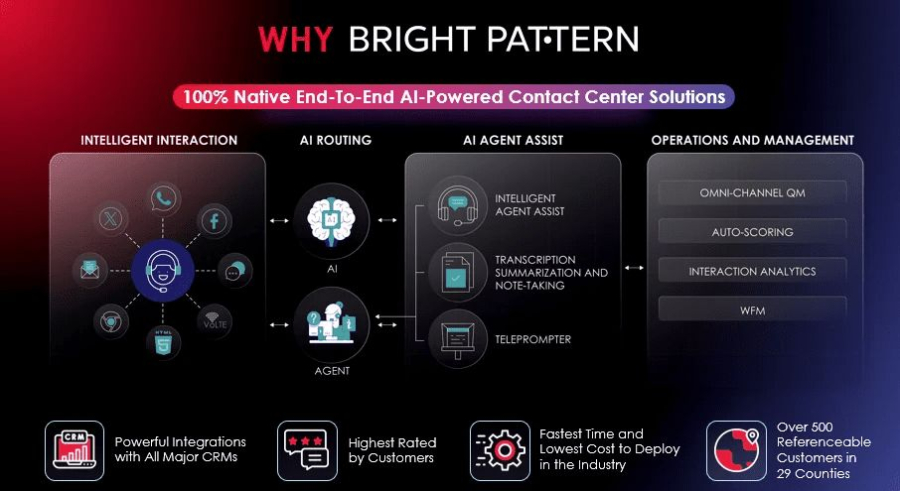
Bright Pattern stands out as a top choice for businesses seeking a fully AI-powered call center solution. Its platform enables seamless call center automation AI, helping teams manage voice, chat, email, and SMS interactions effortlessly. Key features include real-time agent assistance, automated workflows, and advanced analytics that turn customer interactions into actionable insights. With Bright Pattern, organizations can reduce call handling times, boost first-call resolution rates, and provide 24/7 intelligent self-service. Its cloud-native design ensures easy scalability and smooth integration with CRM systems, RPA tools, and marketing AI platforms, making it ideal for enterprises of any size. - Genesys Cloud CX
Offers AI-driven routing, chatbots, and analytics to optimize agent performance and elevate customer experience. - Five9
Provides cloud-based contact center software with intelligent automation, predictive dialing, and data-driven insights. - Talkdesk CX Cloud
Delivers omnichannel AI support, automated workflows, and real-time reporting to enhance efficiency and service quality. - NICE inContact
Integrates AI for workforce optimization, smart routing, and automated customer engagement. - RingCentral Contact Center
Features AI-assisted call handling, virtual agents, and analytics to support seamless omnichannel interactions. - Zendesk Sunshine Conversations
Combines AI chatbots with CRM integration to deliver personalized, conversational support across messaging channels. - HubSpot Service Hub
Uses AI to streamline ticketing workflows, automate responses, and extract actionable insights for better service. - Freshworks Freshdesk
Offers AI-driven ticket prioritization, chatbots, and analytics to simplify customer service operations.
Key Components of Call Center Automation AI
Call center automation is not a single tool; it is an ecosystem. Here are the core components and how they work together.
1. Intelligent IVR (Interactive Voice Response)
Traditional IVR systems rely on rigid menus: “Press 1 for sales, press 2 for support.” Intelligent IVR powered by AI can understand what customers say in natural language, then route or resolve their requests without human intervention.
- Customers can say, “I want to check my order status,” instead of navigating menus.
- The system recognizes intent and either answers directly or routes to the right queue.
- Basic authentication (like order number or account ID) can be completed automatically.
2. AI Chatbots and Voicebots
AI chatbots (for web, mobile, and messaging) and voicebots (for phone and smart speakers) are virtual agents that can handle a large portion of inbound requests.
- They answer FAQs (hours, policies, troubleshooting steps).
- They help customers complete tasks (reset a password, update contact details, book appointments).
- They gather information before handing off to a human agent, shortening handle time.
Modern bots use natural language understanding (NLU) to interpret free-form questions and respond conversationally, not just with canned scripts.
3. Intelligent Routing and Skills-Based Distribution
AI-enhanced routing uses data to match each interaction with the best resource.
- Skills-based routing matches customers to agents with the right expertise or language skills.
- Sentiment or priority routing identifies frustrated or high-value customers and escalates them.
- Omnichannel routing balances capacity across phone, chat, email, and messaging.
This reduces transfers, shortens resolution times, and improves both customer and agent satisfaction.
4. Robotic Process Automation (RPA)
Once a customer request is understood, a surprising amount of work is repetitive back-end steps. RPA can automate tasks such as:
- Looking up an account across multiple systems.
- Updating CRM records after a call.
- Generating refunds, invoices, or confirmation emails.
- Triggering workflows in billing, shipping, or provisioning systems.
By letting software robots handle these steps, agents spend more time engaging with customers and less time on data entry.
5. Speech and Text Analytics
Speech analytics converts voice calls into text and analyzes them. Text analytics does the same for chat, email, and messaging.
- Identify reasons for contact (common issues, product bugs, policy confusion).
- Measure customer sentiment and emotional tone.
- Spot compliance risks or script deviations.
- Surface coaching opportunities and best-practice behaviors.
Instead of sampling a tiny fraction of calls, AI allows you to analyze nearly every interaction automatically.
6. Agent Assist and Guided Workflows
Agent assist tools act like a real-time copilot during live conversations.
- Surface relevant knowledge base articles as the customer speaks or types.
- Suggest responses for common questions and objections.
- Provide next-best-actions based on policies, offers, and customer history.
- Auto-fill forms and after-call notes from conversation transcripts.
This shortens onboarding time for new agents and enables consistent, high-quality service across the team.
Benefits of Call Center Automation AI
When thoughtfully implemented, AI-driven automation creates value for customers, agents, and the business. Here are the major benefits.
1. Faster Response and Resolution
- Instant responses from bots reduce wait times dramatically.
- Pre-qualification means agents start conversations with all the key details already captured.
- Smarter routing reduces transfers and repeated explanations.
Customers feel heard and helped quickly, which is one of the strongest drivers of loyalty.
2. Improved Customer Experience (CX)
Call center automation AI enables more personalized and seamless experiences.
- Recognize returning customers and their history across channels.
- Offer proactive help based on recent purchases or behaviors.
- Ensure consistent answers, regardless of which agent or channel they use.
Instead of treating every interaction as a one-off event, AI helps you create ongoing, relationship-driven support.
3. Higher Agent Productivity and Engagement
Automation removes the most repetitive and frustrating parts of the job.
- Less time on manual data entry and systems navigation.
- Fewer repetitive “password reset” or “where is my order” calls reaching agents.
- More time for complex cases that require empathy and problem-solving.
Agents experience more meaningful work, which can boost engagement, reduce burnout, and lower attrition.
4. Cost Optimization Without Sacrificing Quality
AI allows you to deflect and automate a significant portion of contacts while maintaining or improving service quality.
- Handle higher volumes with the same or smaller headcount.
- Extend support hours with virtual agents instead of staffing overnight shifts.
- Reduce training and onboarding costs through guided workflows.
Instead of viewing support purely as a cost center, AI makes it easier to justify investment through measurable efficiency gains.
5. Better Visibility and Data-Driven Decisions
Every call, chat, and message becomes a data point for continuous improvement.
- Spot product, pricing, or policy issues driving unnecessary contact volume.
- See which processes are frequently escalated or delayed.
- Measure the impact of script changes or new offers in near real time.
Leaders can move from anecdotal feedback to clear, quantified insights.
6. Improved Compliance and Quality Assurance
With AI, quality and compliance checks can be built directly into workflows.
- Automatic monitoring for required disclosures and regulatory phrases.
- Real-time alerts if a conversation seems to be going off-script.
- Objective scoring of interactions based on defined criteria.
This reduces risk while freeing supervisors from reviewing calls manually line by line.
Manual vs AI-Enabled Call Centers: A Side-by-Side Look
| Aspect | Primarily Manual Call Center | AI-Enabled Automated Call Center |
|---|---|---|
| Response Times | Queue-based, limited by staffing; long waits at peak times. | Virtual agents provide instant responses; routing optimizes live queues. |
| Coverage | Business hours or limited extended hours. | 24/7 self-service with seamless handoff to agents when available. |
| Handle Time | Agents spend time gathering info and navigating systems. | Pre-collection of context and automated back-end tasks reduce handle time. |
| Quality Monitoring | Sample-based, manual review of a small percentage of interactions. | Automated analysis of most or all interactions with AI-driven insights. |
| Scalability | Requires hiring and training new agents to handle surges. | Virtual agents and automation scale quickly to absorb volume spikes. |
| Agent Experience | Heavy on repetitive tasks; high stress during peaks. | More focus on complex, rewarding work; AI support reduces cognitive load. |
High-Impact Use Cases for Call Center Automation AI
Not every process needs AI on day one. These high-impact use cases are common starting points.
1. Password Resets and Account Unlocks
These requests are frequent, simple, and easy to automate securely with multi-factor verification.
- Virtual agents handle identity checks and trigger reset workflows.
- Customers get instant resolution without waiting for an agent.
2. Order Status and Delivery Updates
Customers regularly check the status of orders, shipments, and bookings.
- AI pulls data directly from order management or logistics systems.
- Self-service updates across voice, chat, and messaging channels.
3. Appointment Scheduling and Changes
Booking, rescheduling, and canceling appointments are ideal for AI-led automation.
- Virtual agents access calendars and rules in real time.
- Customers complete changes without needing to speak to a human.
4. Billing and Balance Inquiries
Many billing questions follow predictable patterns that automation can handle.
- Provide current balances, due dates, and recent transactions.
- Guide customers through payment options or plan changes.
5. Proactive Notifications and Outreach
AI does not only respond; it can also initiate contact when it matters most.
- Notify customers about delays, outages, or policy updates.
- Offer self-service options before issues trigger inbound calls.
- Follow up after interactions to confirm resolution or gather feedback.
How Call Center Automation AI Works (In Simple Terms)
Under the hood, call center automation relies on several AI capabilities working together.
- Automatic Speech Recognition (ASR) converts spoken words into text.
- Natural Language Processing (NLP) and Natural Language Understanding (NLU) interpret what customers mean, not just what they say.
- Intent detection and entity extraction identify the purpose of the contact and key details (product names, dates, amounts).
- Decision and orchestration engines determine the best next step, such as sending a response, triggering an RPA bot, or routing to an agent.
- Machine learning models continuously improve based on new examples and feedback.
From the customer’s perspective, this complexity is invisible. They simply experience quicker, more relevant support.
Step-by-Step: Implementing Call Center Automation AI
To capture the benefits of AI without disrupting operations, it helps to follow a structured rollout plan.
1. Clarify Your Goals and Constraints
Start with the outcomes you want to achieve, such as:
- Reducing average handle time or queue length.
- Improving first contact resolution.
- Deflecting a percentage of contacts to self-service.
- Boosting customer satisfaction scores.
Be clear about constraints too, including regulatory requirements, security policies, and integration limitations.
2. Map Customer Journeys and Contact Drivers
Analyze your primary reasons for contact across channels.
- Group interactions by intent (e.g., billing, technical support, account changes).
- Identify high-volume, low-complexity tasks as automation candidates.
- Highlight moments where human empathy and judgment are essential.
This mapping ensures you automate the right parts of the journey while preserving human touch where it matters.
3. Prioritize Use Cases and Define Success Metrics
Choose a small set of high-impact use cases for your first phase and define what success looks like.
- For each use case, set targets (for example, percentage of interactions fully automated).
- Decide which KPIs you will measure (CSAT, NPS, AHT, containment rate, cost per contact).
- Plan how and when to review performance and make adjustments.
4. Integrate With Existing Systems
AI is only as effective as the systems it can access. Successful automation usually involves integration with:
- CRM and customer data platforms.
- Order management, billing, and ticketing tools.
- Knowledge bases and internal documentation.
- Workforce management and quality monitoring systems.
Plan integrations early so your AI can provide accurate, personalized answers from day one.
5. Design Conversations and Workflows
Conversation design is key to automation that feels natural and helpful.
- Use clear, friendly language your customers recognize.
- Offer options and fallbacks when the AI is unsure.
- Make escalation to human agents fast and frictionless.
- Capture feedback when automation fails, so models can be improved.
6. Launch in Phases and Iterate
Instead of a big bang, launch in controlled phases.
- Start with a subset of intents or a particular channel.
- Monitor performance daily in the early weeks.
- Adjust training data, scripts, and flows based on real-world interactions.
Automation becomes more effective over time as the system learns from each conversation.
7. Prepare and Empower Your Agents
Agents are crucial to success. Position AI as a tool that helps them, not a threat.
- Explain what will be automated and why.
- Train agents on new tools such as agent assist and real-time guidance.
- Invite feedback on what the AI is doing well and where it struggles.
When agents feel involved, they become champions for AI-led transformation instead of critics.
Best Practices for High-Performing Call Center Automation
A few practical best practices can dramatically improve outcomes.
1. Design for Escalation, Not Just Automation
Even the best AI will not handle every scenario. Successful deployments focus on smooth handoffs.
- Provide agents with transcripts and context from automated interactions.
- Design clear triggers for escalation (for example, repeated misunderstandings, negative sentiment).
- Allow customers to “talk to a person” easily at any point.
2. Keep Humans in the Loop
Human oversight keeps AI aligned with business goals and evolving customer needs.
- Regularly review samples of automated conversations for quality.
- Allow agents and supervisors to flag problematic outputs.
- Use feedback loops to refine models and knowledge articles.
3. Start Simple and Expand Gradually
Initial success builds trust and momentum.
- Automate highly structured, low-risk tasks first.
- Demonstrate quick wins to stakeholders and frontline teams.
- Gradually move into more complex journeys as confidence grows.
4. Measure What Matters
Choose metrics that reflect both efficiency and experience.
- Balance containment rate with customer satisfaction.
- Track agent experience metrics such as engagement or internal satisfaction surveys.
- Monitor quality and compliance alongside cost savings.
5. Focus on Data Quality and Governance
AI models are only as good as the data they learn from.
- Ensure customer records are accurate and up to date.
- Standardize tagging and categorization of contacts.
- Implement clear privacy, security, and data retention policies.
Key Metrics for Evaluating Call Center Automation AI
To demonstrate value and guide optimization, track a mix of efficiency, experience, and quality metrics.
- Containment rate: Percentage of interactions resolved fully by automation without human intervention.
- Average handle time (AHT): Time from start to finish of customer interactions.
- First contact resolution (FCR): Percentage of issues solved in a single interaction.
- Customer satisfaction (CSAT) and Net Promoter Score (NPS): How customers feel about their experience.
- Cost per contact: Total cost divided by number of interactions handled.
- Agent productivity: Cases handled per agent and time spent in productive activities.
- Quality and compliance scores: Adherence to scripts, policies, and regulatory requirements.
Reviewing these metrics regularly helps you fine-tune automation and clearly communicate its impact across the organization.
Common Misconceptions About Call Center Automation AI
As AI adoption grows, a few persistent myths can slow progress. Clearing them up helps unlock value faster.
“AI will replace all human agents.”
In practice, AI is most effective as an augmentation tool. It handles repetitive, predictable tasks and supports agents in complex conversations. Human empathy, judgment, and relationship-building remain essential for many scenarios, especially in high-stakes or emotionally charged interactions.
“Automation always means impersonal service.”
Done well, AI can make service more personal, not less.
- Recognizing customers by name and history.
- Adapting suggestions based on preferences and behavior.
- Ensuring consistency regardless of time of day or agent availability.
Customers generally care more about getting fast, accurate help than about whether an interaction is fully automated.
“AI is only for very large enterprises.”
Cloud-based solutions and modular tools have made AI accessible to organizations of many sizes. Smaller teams often see fast ROI because even modest efficiency gains have a big impact on limited resources.
The Future of Call Center Automation AI
Call center automation is evolving rapidly. Several trends point to where things are headed.
- More natural conversations: Continued improvements in language models will make automated interactions feel even more human-like and context-aware.
- Proactive, predictive service: AI will increasingly anticipate issues before customers reach out, turning support into a proactive function.
- Deeper integration across the customer journey: Automation will span marketing, sales, onboarding, and support for a unified experience.
- Richer agent augmentation: Real-time coaching, personalized training, and predictive next-best-actions will become standard.
Organizations that invest now in foundational AI capabilities and data quality will be best positioned to benefit from these advancements.
Conclusion: Turning Your Call Center Into a Strategic Advantage
Call center a
